Technology
Dec 1, 2025
Traditional ICP models break the moment new functions emerge. Titles shift too slowly, org charts lag behind reality, and none of these structures reflect who actually understands or cares about rapidly evolving domains like GEO or AEO. To solve this, we needed a way to observe behavior directly - not infer motivation from a static label. This only became possible once reasoning LLMs arrived.

Co-Founder & CTO @ OpenFunnel
Interaction Patterns as Ground Truth
LLMs allow us to process public interaction signals at scale:
What people engage with
Who they follow
Which conversations they participate in
How they react to competitors
What topics consistently draw their attention
These signals are far more revealing than titles because they show intent in motion. And with reasoning LLMs, we can interpret what these patterns mean, not just aggregate them.
This led us to build interaction clusters inside accounts - behavioral groupings that surface the people leaning into new functions long before org structures acknowledge it.
Finding the Real Operators Behind GEO and AEO
For GEO and AI-SEO customers, this changed everything.
When an account showed GEO activity, the system could immediately identify the individuals already operating in that motion — often months before their title caught up.
LLMs removed the dependency on job labels entirely.
We could now see:
Who needed the solution
Who cared about the domain
Who was already shaping the function internally
This allowed us to map emerging operators across the ecosystem, revealing the early adopters pushing GEO/AEO inside larger organizations.
Operators Actively Shaping GEO and AEO
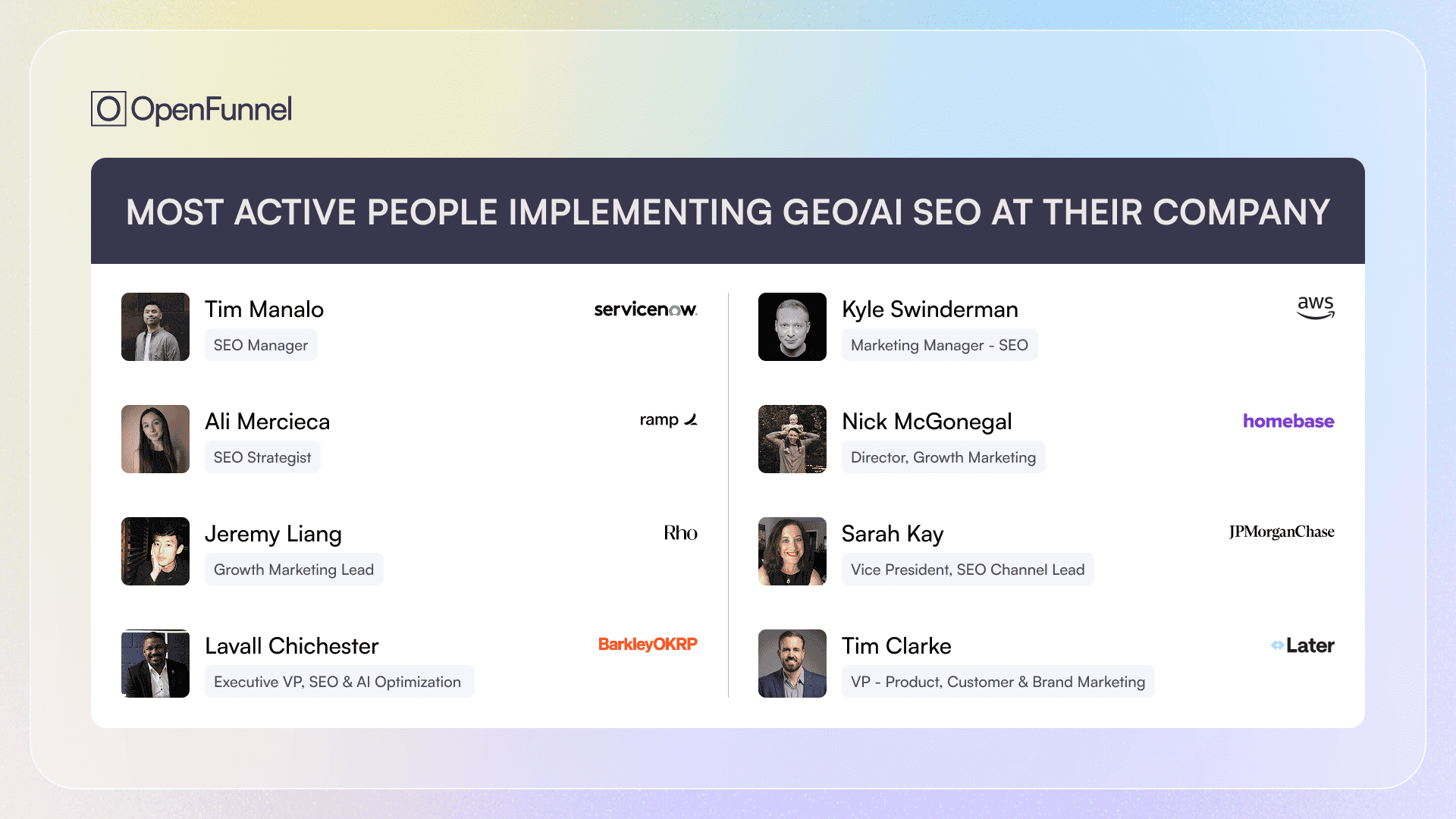
Reasoning over interaction clusters surfaced the following leaders who consistently drive thinking around GEO, AEO, and AI-driven discovery:
Tim Manalo (ServiceNow) – Exploring AI discovery patterns and the evolution of AIO-driven SEO.
Kyle Swinderman (AWS) – Engaging deeply with AEO and GEO as AWS evolves toward AI-native search.
Ali Mercieca (Ramp) – Leaning into AI-first SEO and generative visibility models.
Jeremy Liang (Rho) – Merging technical SEO with LLM-aware optimization patterns.
Sarah Kay (JPMorgan Chase) – Active contributor in GEO and AI-search performance conversations.
Lavall Chichester (BarkleyOKRP) – Applying GEO frameworks across SGE, ChatGPT, and Perplexity ecosystems.
Tim Clarke (Later) – Driving AI-powered discovery and content workflows.
These individuals reflect how new functions form — not through titles, but through behavior, participation, and signal density.
LLMs Reveal Who Actually Runs Emerging Functions
LLMs made one thing clear:
The real operators show up in patterns, not job descriptions.
By reasoning over interactions instead of relying on outdated labels, GTM systems can now identify the people shaping new categories the moment those categories appear.
Reasoning LLMs surface the real operators inside accounts by analyzing behavior, not titles — enabling accurate ICP discovery in emerging functions like GEO and AEO.